
On 15 August 1947, as celebrations marked India’s independence across the country, Mahatma Gandhi was not in New Delhi. He remained in Calcutta, staying at a dilapidated house called Hyderi Manzil in the Beliaghata neighbourhood. The city was still reeling from communal violence linked to the Partition, and Gandhi had deliberately chosen to be present in one of its most affected areas. His stay, lasting from 13 August to 7 September 1947, is remembered as a period when personal presence and moral pressure helped restore a fragile calm.
The Decision to Remain in Calcutta
Gandhi had arrived in the region intending to proceed to Noakhali, where earlier communal disturbances had caused deep suffering. Muslim leaders in Calcutta, including Huseyn Shaheed Suhrawardy, the former Premier of Bengal, urged him to stay and help restore peace in the city first. Gandhi agreed on clear conditions. He insisted on living in a locality that had experienced riots, without special security arrangements, and required that Suhrawardy stay with him. The arrangement was meant to demonstrate that Hindus and Muslims could share the same space and work together for harmony.
Hyderi Manzil, located at 150 Beliaghata Main Road, was selected for this purpose. It was a typical baganbari, or garden house, with Grecian pillars, rooms arranged around a central space, large windows, and a traditional pond on a sprawling plot. The property, associated with a Muslim family of Dawoodi Bohra origin and named after a daughter of the household, stood in an area with mixed populations and nearby localities that had seen serious unrest. At the time of Gandhi’s arrival the house was in poor condition—cracked walls, broken windows, limited facilities, and only one usable toilet. Only a couple of rooms were made habitable for him and his small group of companions.
Independence Day at Hyderi Manzil
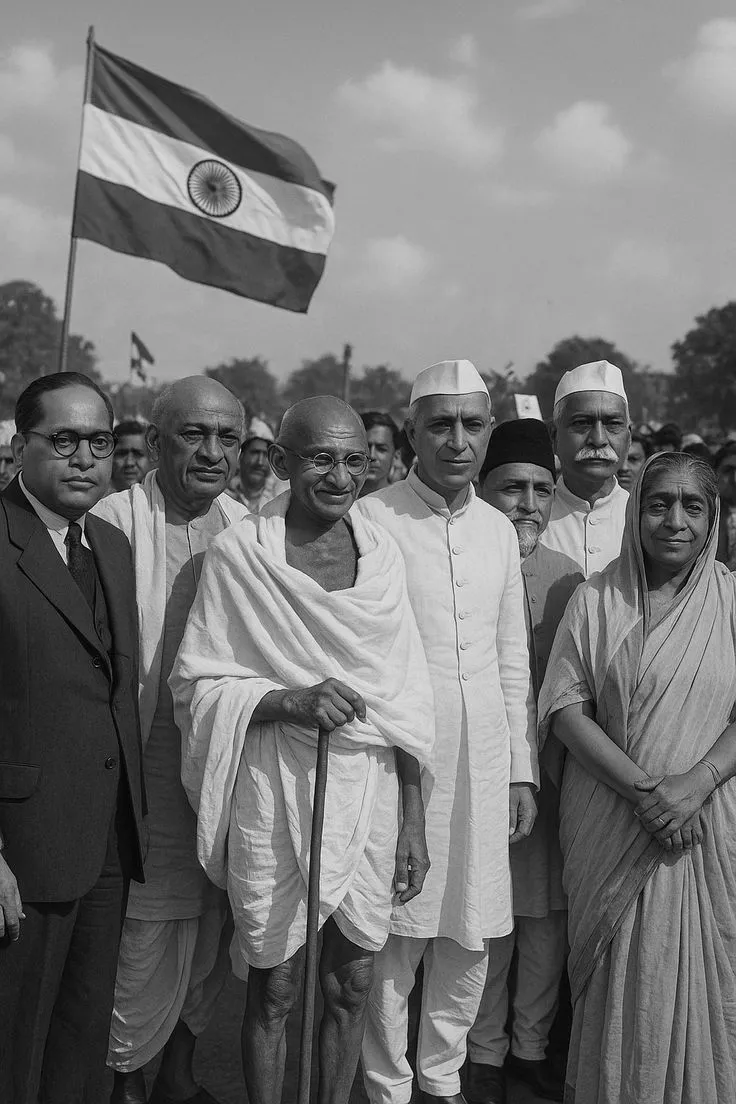
Gandhi moved into the house on the afternoon of 13 August. On 15 August, while the rest of the nation celebrated the transfer of power, he observed a day of fasting and prayer. He described the occasion as one that called for both celebration and sorrow, given the violence that had accompanied the end of British rule. Crowds of Hindus and Muslims gathered outside the house from early morning, seeking his darshan. Some Muslim residents who were observing the Ramzan fast waited to break it only after seeing him. The atmosphere around Hyderi Manzil that day stood in contrast to the formal ceremonies in the capital.
His presence initially appeared to have a calming effect. People from both communities moved more freely in parts of the city, and many attributed the temporary reduction in tension to Gandhi’s decision to live among those most affected by the riots.
The Fast of September 1947
The relative peace proved short-lived. Fresh outbreaks of violence occurred towards the end of August. On 1 September, at the age of 78, Gandhi began an indefinite fast, declaring that the unrest must end. He continued the fast for about 73 hours. On 4 September, leaders and individuals involved in the rioting came to Hyderi Manzil. They offered confessions, surrendered weapons, and provided written assurances of peace. Only after these commitments did Gandhi end his fast.
The episode became known as the “miracle of Calcutta.” It demonstrated Gandhi’s method of combining personal example, moral pressure through fasting, and direct engagement with those responsible for violence. The house itself turned into a focal point. Students, political leaders, journalists and ordinary citizens visited in large numbers. Gandhi’s daily routine—prayers, discussions, walks in the neighbourhood—continued even under difficult physical conditions.
Legacy of the Stay
Gandhi left Hyderi Manzil on 7 September 1947 for Delhi. It was his last visit to Calcutta. The house later fell into neglect before being restored and renamed Gandhi Bhavan. It is now maintained as a memorial associated with the events of those weeks. Descendants connected to the original family, such as Aquil Busrai, still recall the property’s scale and the weight of its history. For them, the building carries both personal memories and the larger significance of the period when Gandhi chose to confront communal violence at its source rather than join the formal celebrations of independence.
Why the Choice Mattered
Gandhi’s decision reflected a consistent principle. Independence, in his view, could not be separated from the moral condition of society. Celebrating freedom while large numbers of people lived in fear of communal attack would have been incomplete. By placing himself in a riot-affected Muslim-majority locality, sharing the space with a prominent Muslim League leader, and later undertaking a fast when violence returned, he sought to make communal harmony a lived reality rather than a slogan.
The weeks at Hyderi Manzil showed both the possibilities and the limits of such an approach. The calm achieved was real but temporary, and the deeper wounds of Partition continued elsewhere. Yet the episode remains a powerful illustration of Gandhi’s belief that leadership required physical presence in the places of greatest suffering and a willingness to stake personal well-being on the restoration of peace.
In the memory of the city and the nation, Hyderi Manzil stands as the site where the Father of the Nation spent the first days of free India not in ceremony but in the difficult work of reconciliation. His choice continues to invite reflection on the relationship between political freedom and social harmony.
Read more – grammarthink.com
