
Starting to invest can feel overwhelming, especially with market fluctuations and many product choices available. In 2026, beginners in India have access to a clear range of options that balance safety, growth potential, tax efficiency, and accessibility. The right approach depends on your goals, time horizon, and comfort with risk. Short-term needs call for capital protection, while long-term goals allow room for market-linked growth. Building a simple, diversified foundation and investing consistently through systematic plans often proves more effective than chasing high returns.
Why Beginners Should Start Investing in 2026
India’s economy continues to support long-term wealth creation through structural themes such as manufacturing, renewables, fintech, and infrastructure. Domestic investor participation remains strong, with systematic investment plans attracting substantial monthly inflows. Inflation remains a key consideration—fixed returns that look attractive on paper can lose purchasing power after tax if they fall short of rising costs. A balanced mix of government-backed schemes, bank deposits, mutual funds, and gold helps address different needs while managing risk.
The most practical starting point is matching money to when you will need it. Funds required within one to three years belong in safer instruments. Money earmarked for goals five years or longer can include equity exposure for better inflation-beating potential over time.
Safe and Low-Risk Options for Capital Protection
For beginners prioritizing safety, several government-backed and bank products offer predictability.
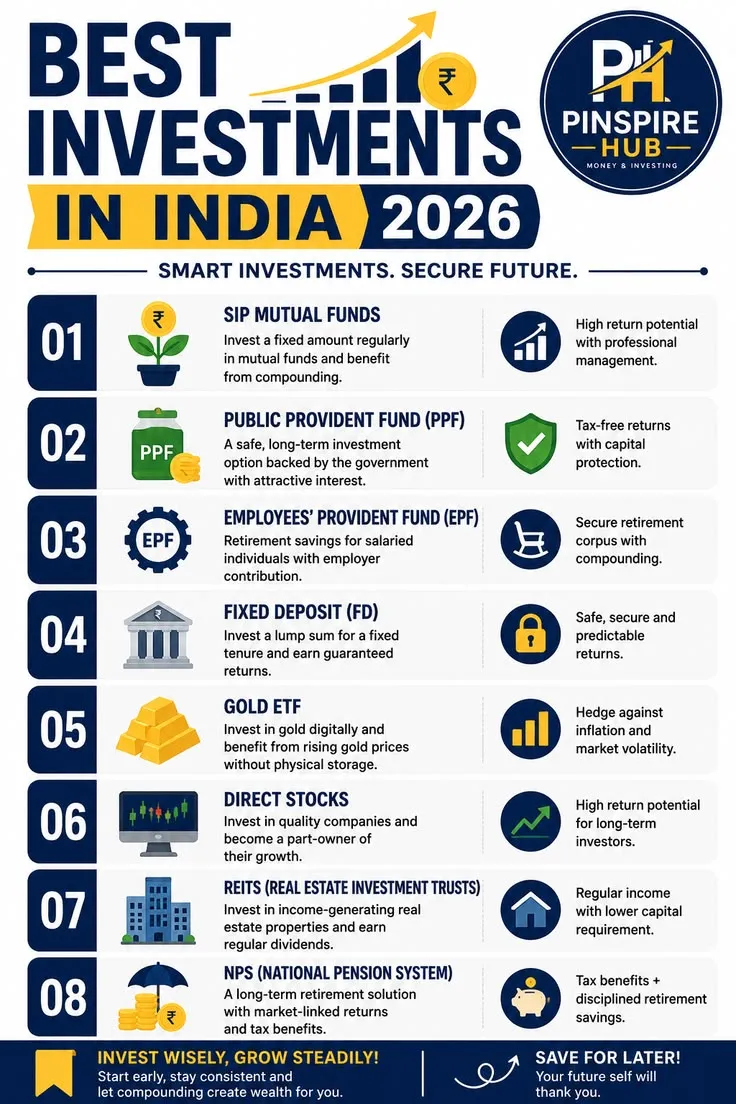
Bank Fixed Deposits remain one of the simplest choices. You deposit a lump sum for a fixed tenure and earn a predetermined interest rate. Major banks currently offer rates in the range of roughly 6.25 percent to 6.65 percent for one- to five-year tenures, with some small finance banks providing higher rates. Deposits are insured up to ₹5 lakh per bank under the deposit insurance scheme. Interest is taxable as per your slab, which reduces post-tax returns for those in higher brackets. Fixed deposits work well for emergency funds or short- to medium-term goals where certainty matters more than growth.
Public Provident Fund stands out for long-term, risk-free savings. It is fully government-backed with a current interest rate of 7.1 percent, compounded annually. The scheme carries a 15-year tenure (extendable) and offers complete tax exemption under the Exempt-Exempt-Exempt status—contributions qualify for deduction under Section 80C (up to the annual limit), interest is tax-free, and the maturity amount is tax-free. Minimum yearly investment is low, making it accessible. Partial withdrawals and loans are available after specified years. PPF suits retirement planning or any goal spanning a decade or more.
Other post-office and small-savings schemes provide additional safety. National Savings Certificates offer around 7.7 percent with a five-year lock-in and Section 80C benefits. Senior Citizens Savings Scheme delivers higher rates for eligible individuals aged 60 and above. These instruments carry sovereign guarantee and appeal to conservative investors seeking steady, predictable growth.
Debt mutual funds and government securities can complement fixed deposits. Debt funds invest in bonds and money-market instruments. Returns are market-linked rather than guaranteed, yet certain categories may deliver better post-tax outcomes than fixed deposits for investors in higher tax brackets, depending on holding period and prevailing rules. Treasury bills and government securities provide sovereign-backed options with fixed returns if held to maturity.
Growth-Oriented Options for Long-Term Wealth Creation
Once an emergency fund and basic safety net are in place, beginners can allocate toward growth.
Equity mutual funds through Systematic Investment Plans form the core recommendation for long-term goals. These funds pool money and invest primarily in stocks. Index funds that track broad benchmarks such as the Nifty 50 offer low-cost, diversified exposure without the need to select individual stocks. Large-cap and flexi-cap categories are generally suitable for first-time investors because they focus on more established companies and allow flexibility across market segments. Historical long-term category averages for equity funds have ranged higher than fixed-income options, though short-term volatility is normal. Starting with monthly SIPs of even a few hundred or thousand rupees builds the habit of regular investing and averages purchase costs over time.
Equity Linked Savings Schemes combine growth potential with tax benefits. These equity-oriented funds carry a three-year lock-in per installment and qualify for Section 80C deduction under the old tax regime. They suit investors who want equity exposure while utilizing tax-saving limits.
National Pension System provides a low-cost, market-linked route focused on retirement. It allocates across equity, corporate bonds, and government securities according to the chosen scheme. Tax benefits under Sections 80C and 80CCD make it attractive for long-term retirement planning, though liquidity is restricted until the specified age.
Gold as a Portfolio Diversifier
Gold continues to serve as a useful hedge and diversification tool. Gold exchange-traded funds and gold mutual funds have delivered strong recent performance relative to many equity categories in certain periods. Sovereign Gold Bonds add a fixed coupon on top of potential price appreciation and offer tax advantages on capital gains when held to maturity through the designated channel. Experts commonly suggest a modest allocation—often around 5 to 15 percent—rather than making gold the primary holding. It works best as insurance against uncertainty rather than a standalone growth engine.
Building a Simple Beginner Portfolio
A practical approach for most beginners involves layering products by purpose. Keep three to six months of expenses in liquid instruments such as savings accounts, liquid funds, or short-term fixed deposits. Use Public Provident Fund or National Savings Certificates for long-term safe compounding and tax efficiency. Channel regular savings into equity mutual fund SIPs for goals beyond five years. Add a small gold allocation for balance. Experts often recommend spreading any larger sum, such as a bonus, across mutual funds, fixed deposits, and gold rather than concentrating in one asset.
Consistency matters more than perfect timing. Starting early allows compounding to work. Review the portfolio periodically, but avoid frequent changes based on short-term market moves. Understand the tax implications under your chosen regime—old or new—as this affects the relative attractiveness of Section 80C products.
Practical Steps to Get Started
Open necessary accounts through a bank, post office, or regulated investment platform. Complete know-your-customer formalities once. Begin with amounts you can sustain without financial stress. Prefer direct plans of mutual funds where available to keep costs lower. Educate yourself on basic concepts such as risk, diversification, and time horizon before increasing exposure. Avoid products that promise unusually high returns with little risk—they rarely deliver as advertised.
In 2026, the combination of accessible digital platforms, strong domestic participation, and a wide menu of regulated products makes it easier than ever for beginners to begin building wealth. Focus on safety first, add growth gradually through systematic investing, diversify thoughtfully, and stay consistent. Over time, this disciplined approach supports financial goals more reliably than any single product or market prediction.
Read more – starbiofact.com
