
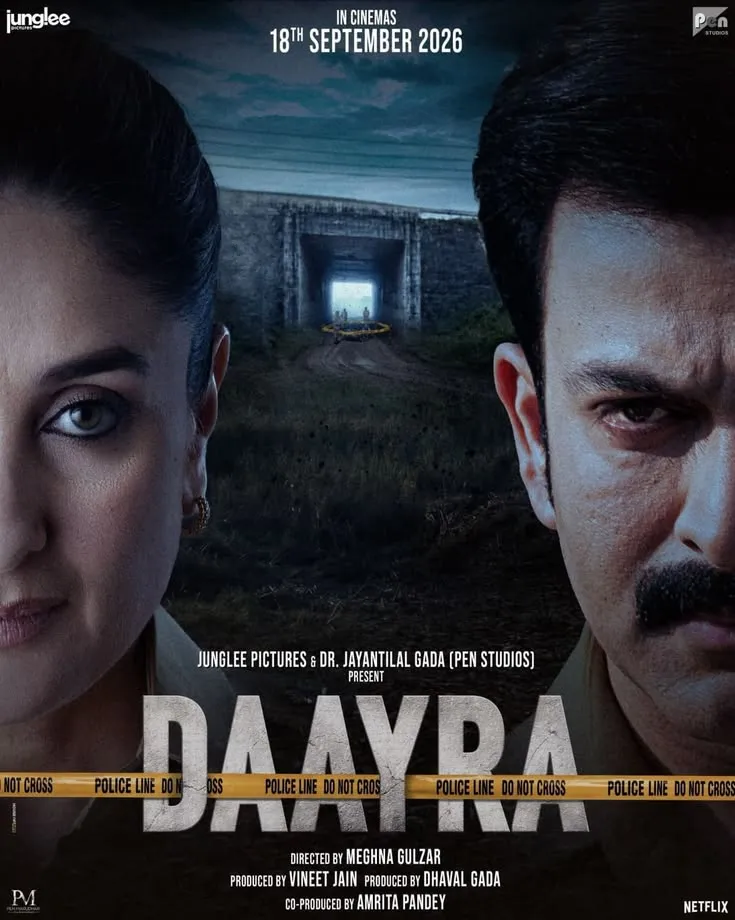
Meghna Gulzar’s Daayra enters theatres as a crime thriller that wants to interrogate the uneasy space between justice and vengeance. Starring Prithviraj Sukumaran and Kareena Kapoor Khan as senior police officers on opposing sides of a controversial case, the film raises pointed questions about extrajudicial action, institutional failure and the cost of public outrage. Yet for all its seriousness of intent, Daayra struggles to maintain tension and never fully resolves how it wants to use one of its biggest stars.
A Case That Divides Two Officers
The story begins with the rape and murder of a young woman, an act that triggers nationwide anger. DCP Raman Kumar, played by Prithviraj, leads a team that tracks down the four accused and kills them in what is presented as an encounter. The action is celebrated by many as swift justice. Into this charged atmosphere steps DCP Ajooni Kohli, played by Kareena Kapoor Khan, who is tasked with investigating the circumstances of the encounter.
The central conflict is ideological rather than personal. Raman believes the system is too slow and too compromised to deliver meaningful consequences for such crimes. Ajooni insists on procedure, accountability and the rule of law even when the outcome feels unsatisfying. Their opposing approaches form the spine of the narrative as the investigation unfolds and past actions come under scrutiny.
The film is loosely inspired by real events that remain raw in public memory. Gulzar, who has previously examined morally complex true-crime terrain, once again chooses a subject that resists easy answers. The title itself—Daayra, suggesting a circle or boundary—hints at the closed loops of crime, response and consequence that the story seeks to explore.
Prithviraj’s Contained Intensity
Among the cast, Prithviraj emerges as the clearest strength. His Raman is controlled, purposeful and largely free of performative rage. He conveys a man who has already decided that certain lines must be crossed and who feels little need to justify himself beyond results. The performance is contained yet effective; it never tips into cartoonish vigilantism, which allows the character’s moral certainty to feel genuinely unsettling rather than simply heroic.
Supporting players around him, including colleagues who understand the practicalities of pursuit and confrontation, add texture to the operational sequences. These stretches—focused on investigation, tracking and the mechanics of the manhunt—are among the film’s more gripping passages. Gulzar stages them with a procedural clarity that recalls her stronger work in the genre.
The Problem of Positioning Kareena Kapoor
Kareena Kapoor Khan’s Ajooni is written as the counterweight to Raman’s certainty. She is composed, precise and committed to process. In individual scenes she registers authority and quiet resolve, particularly in moments that require listening rather than speechifying. Yet the film never seems fully decided about how to place her within the narrative.
At times Ajooni functions as a star presence whose appearance carries its own weight. At others she is required to operate as a pure character inside a system. The result is a role that feels intermittently present rather than consistently driving the story. Several viewers and critics have noted the limited or spaced-out screen time, which reinforces the sense that the film is unsure how much of the emotional and investigative load it wants her to carry.
This uncertainty weakens the central confrontation of ideas. For the moral debate between process and outcome to land with force, both positions need equal dramatic weight and sustained development. When one side feels under-served, the argument itself loses sharpness.
Moral Ambition and Narrative Hesitation
Daayra is most interesting when it sits with discomfort. It shows the public hunger for visible punishment, the institutional pressures that shape police behaviour, and the personal toll on families left behind. It is less successful when it softens the implications of extrajudicial action or allows the story to drift into familiar procedural rhythms without deepening the ethical stakes.
The film’s pacing becomes an issue in the middle stretches. What begins with urgency gradually settles into a more measured, sometimes sluggish investigation. The cat-and-mouse tension promised by the premise does not always materialise. By the time the principal characters face each other more directly, some of the earlier charge has dissipated.
Gulzar’s direction retains her characteristic restraint. She avoids sensationalising the central crime and keeps the tone serious. That choice is admirable, yet it also places greater pressure on the screenplay to generate intellectual and emotional momentum through character and argument rather than through set-piece drama. On that front the film is only partially successful.
Performances Beyond the Leads
Away from the two DCPs, the supporting cast provides some of the film’s most affecting moments. The portrayal of the victim’s family, particularly the mother’s grief and frustration, grounds the story in human consequence rather than abstract debate. These sequences remind the audience what is actually at stake when systems fail and when alternative forms of “justice” take their place.
The ensemble of officers and officials around the main investigation is functional if not always distinctive. A few smaller roles land with clarity; others remain schematic. The film’s visual and editorial style supports a realistic register, with editing that links past and present without excessive flourish.
A Film Caught Between Intent and Execution
Daayra wants to be a thoughtful examination of the boundaries of justice in a society that has grown impatient with legal delays. It has the right ingredients: a provocative premise, two capable lead actors, a director experienced with morally grey material, and a refusal to reduce everything to simple heroism. What it lacks is the sustained dramatic focus and structural confidence to turn those ingredients into a fully compelling whole.
Prithviraj’s performance gives the film a centre of gravity. He makes Raman’s conviction legible without demanding that the audience fully endorse it. Kareena Kapoor Khan brings professionalism and presence, yet the writing and staging never quite solve the question of how her character should function inside the story. The result is a film that raises important issues, stages several strong individual scenes, and still leaves the sense that it has not pushed its own arguments as far as they could go.
In the end, Daayra is a serious-minded crime drama that impresses in parts and frustrates in others. It is worth watching for Prithviraj’s controlled work and for the questions it places on the table. Viewers hoping for a tighter, more decisive exploration of those questions may find the experience only partially satisfying. The film circles its themes with care; it does not always close the distance.
Read more – blessandseemusic.com
