
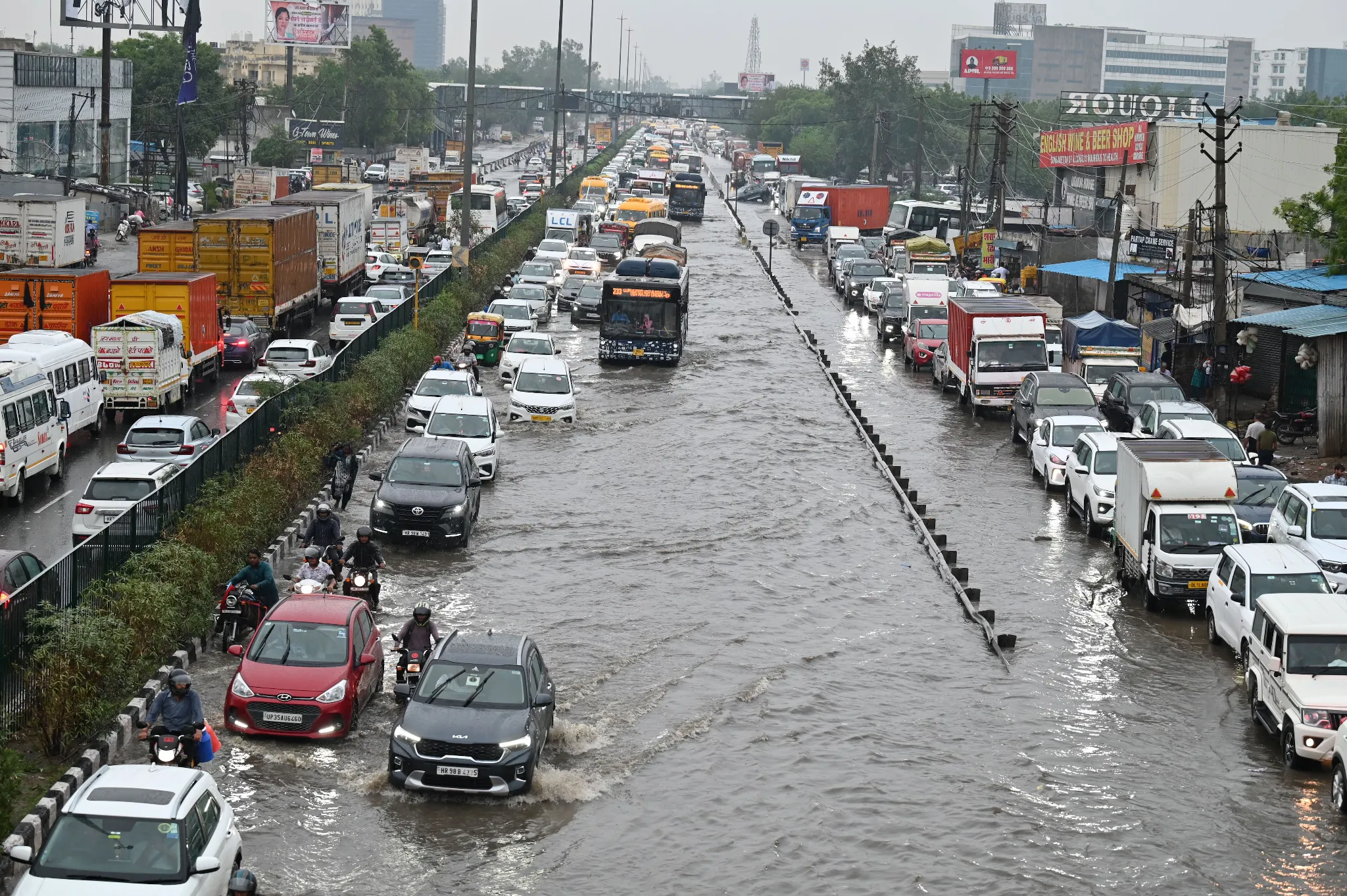
Gurugram’s recurring waterlogging and traffic disruption have once again placed the city’s urban infrastructure under the spotlight. Amid heavy rainfall, the Centre has reviewed several major projects linked to Gurugram’s future mobility, sewerage and urban development, with Minister of State for Housing and Urban Affairs Tokhan Sahu chairing meetings on the Gurugram Metro Connectivity Project, AMRUT 2.0 and CITIIS 2.0.
The review comes at a time when flooded roads and disrupted traffic are raising questions about whether existing infrastructure can keep pace with Gurugram’s rapid urban growth. The Centre’s focus was not limited to waterlogging alone. It also examined project implementation, coordination between agencies and the removal of bottlenecks that can delay large public infrastructure projects.
The discussions are important because Gurugram’s future depends on several interconnected systems. Better public transport can reduce dependence on roads, while stronger sewerage and sanitation infrastructure can improve urban resilience. At the same time, climate-responsive planning and efficient waste management are increasingly important as cities face more intense weather events.
Heavy Rain Puts Gurugram Infrastructure Back in Focus
Heavy rainfall recently caused waterlogging across several parts of Gurugram, disrupting traffic and affecting daily life. Reports highlighted flooded stretches and difficult road conditions, once again bringing attention to the city’s drainage and civic infrastructure.
The latest review therefore comes against a backdrop of an immediate urban problem.
However, the projects reviewed by the Centre are much broader than emergency measures for clearing flooded roads. They form part of longer-term efforts to improve transportation, water and sanitation services and climate resilience.
The central question for residents is how quickly these projects can move from planning and implementation to visible improvements on the ground.
Tokhan Sahu Reviews Gurugram Metro Connectivity Project
One of the key projects reviewed by Tokhan Sahu was the proposed Gurugram Metro Connectivity Project, which will connect Millennium City Centre with Cyber City and include a spur towards the Dwarka Expressway.
The project is being implemented through Gurugram Metro Rail Limited (GMRL). Officials briefed the minister about planning, implementation, coordination between agencies and issues requiring timely resolution.
The emphasis on coordination is significant because large urban transport projects typically involve multiple agencies and approval processes.
For Gurugram, improved metro connectivity is expected to strengthen public transportation links between important employment and residential areas. The city’s rapid expansion has created increasing pressure on road-based transport, making mass transit an important part of its long-term urban planning.
The Centre has stressed that implementation bottlenecks need to be addressed quickly so that the project can progress according to schedule.
Why the Metro Project Matters for Gurugram
Gurugram is one of India’s major corporate and technology hubs, with large employment centres spread across different parts of the city.
A stronger metro network can provide an alternative to private vehicles and road-based commuting. Better connectivity can also make movement between business districts, residential areas and transport corridors more convenient.
The proposed connection between Millennium City Centre and Cyber City, along with the Dwarka Expressway spur, is therefore strategically important.
At the same time, a metro system alone cannot resolve every urban infrastructure challenge. Roads, drainage, sewerage, public transport integration and land-use planning must work together for the city to become more resilient.
AMRUT 2.0 Gets Major Attention
Another major focus of the review was AMRUT 2.0, the Centre’s urban water and sanitation mission.
According to the Ministry, ₹71,133 crore has been allocated for sewerage and septage infrastructure under AMRUT 2.0. This represents nearly 36% of the mission’s total approved project cost of ₹1,97,191 crore.
The scale of this investment shows the importance being given to wastewater and sanitation infrastructure.
At present, 394 sewerage projects worth around ₹47,230 crore are under implementation. Once completed, these projects are expected to provide new sewerage connections to approximately 48.76 lakh households, while another 60.59 lakh households are expected to benefit from upgraded or improved services.
These figures demonstrate that sewerage infrastructure is a major component of India’s broader urban development programme.
Sewerage and Waterlogging: Why Infrastructure Planning Matters
Waterlogging is influenced by several factors, including rainfall intensity, drainage capacity, land use and the condition of existing water channels. Sewerage systems and stormwater drainage are not identical systems, but effective urban planning requires different water-management networks to function together.
The Centre’s AMRUT 2.0 review also discussed the relationship between sewerage systems and on-site sanitation systems. The Ministry clarified that the two do not necessarily have to be treated as mutually exclusive and can coexist depending on local requirements and scientific planning.
This approach is important for rapidly developing cities where infrastructure needs can vary considerably between established neighbourhoods, newly developed areas and peripheral zones.
AMRUT 2.0 Coverage Also Discussed
The review addressed observations made in the 10th Report of the Parliamentary Standing Committee on Housing and Urban Affairs.
The Ministry explained that AMRUT 2.0 covers 500 cities, representing around 7.41 crore urban households based on 2025 data reported by those cities. The Parliamentary Standing Committee had considered a much wider universe of approximately 4,900 urban cities and around 11.32 crore households while making its assessment.
The difference in the populations and cities considered is important when interpreting coverage figures.
Based on data reported by AMRUT cities, the Ministry put the mission’s actual coverage at approximately 55%.
The discussion highlights why programme coverage must be assessed against the specific scope and target population of a scheme rather than through a broader urban universe alone.
Implementation Delays Remain a Challenge
One of the important issues raised during the review was the difficulty of implementing large infrastructure projects on time.
The Ministry noted that projects can face delays because of land-related problems, public objections, multiple departmental clearances and No Objection Certificates. Some of these matters fall under state-government jurisdiction.
For citizens, however, the distinction between central, state and local responsibilities can be less important than the final outcome.
Residents ultimately want completed roads, functioning sewerage networks, reliable public transportation and infrastructure capable of handling heavy rainfall.
That is why Sahu stressed closer coordination between stakeholders, continuous monitoring and timely resolution of bottlenecks.
CITIIS 2.0 and Climate-Ready Cities
The review also covered CITIIS 2.0, another programme aimed at strengthening sustainable urban development.
Sahu examined city-level implementation and the progress of State Climate Cells, with discussions focusing on climate-responsive urban development. The meeting also reviewed proposed solid-waste-management interventions for Bilaspur, with an emphasis on sustainable and scientifically planned systems.
The inclusion of climate planning is increasingly relevant for Indian cities.
Urban infrastructure has to be designed not only for current population and traffic levels but also for changing environmental conditions. The Centre has separately highlighted the role of AMRUT 2.0’s water-management initiatives in strengthening urban water security and reducing risks associated with urban flooding.
Gurugram’s Waterlogging Problem Needs Long-Term Solutions
Recent flooding has once again demonstrated the pressure on Gurugram’s urban systems. The city’s rapid growth has created new demands on roads, drainage, sanitation and public transportation.
A review meeting cannot solve these challenges by itself. The real impact will depend on how quickly decisions are translated into completed infrastructure and whether different agencies work together effectively.
The latest review is nevertheless significant because it brings mobility, sanitation and climate-responsive development into the same wider conversation about urban infrastructure.
What Residents Can Expect From the Projects
For Gurugram residents, the expected benefits of these projects extend beyond individual schemes.
Better Public Transport
The proposed metro connectivity can strengthen mass transit links across major parts of the city.
Improved Sanitation
AMRUT 2.0 sewerage and septage projects are aimed at expanding connections and improving sanitation services.
Stronger Urban Planning
CITIIS 2.0 and climate-related initiatives can encourage cities to consider environmental risks while planning infrastructure.
Greater Accountability
Regular monitoring and inter-agency coordination can help identify delays and push projects towards timely completion.
The actual benefits, however, will depend on implementation quality and whether projects are completed within reasonable timelines.
The Bigger Urban Development Picture
Gurugram’s current situation illustrates a challenge facing many rapidly growing Indian cities: infrastructure must expand as quickly as urban populations, businesses and housing.
Transport projects cannot be planned separately from water management. Sewerage systems cannot be considered without understanding local settlement patterns. Climate resilience cannot be treated as an optional feature of urban development.
The Centre’s latest review reflects an effort to examine these interconnected issues through several major programmes.
Conclusion
The Centre’s review of Gurugram’s Metro Connectivity Project, AMRUT 2.0 and CITIIS 2.0 comes at an important moment for the city. Heavy rainfall and recurring waterlogging have once again exposed the pressure on Gurugram’s urban infrastructure, while major development projects are being pursued to improve mobility, sanitation and climate resilience.
Minister Tokhan Sahu’s review placed particular emphasis on faster implementation, coordination among agencies and removing bottlenecks. The scale of AMRUT 2.0’s sewerage investment, with ₹71,133 crore allocated and 394 projects under implementation, underlines the national importance of improving urban sanitation infrastructure.
For Gurugram, the challenge now is to turn reviews, approvals and investments into visible results. A better-connected metro network, stronger sanitation systems and climate-responsive urban planning can help build a more resilient city—but only if implementation keeps pace with Gurugram’s rapid growth and the increasingly urgent demands placed on its infrastructure.
Read more – toolsbyalaikas.com
