
Introduction: The Evolution of Mobile Networks
Mobile networks have transformed how we communicate, work, and access information, with 4G and 5G representing significant milestones in this progression. While 4G brought widespread high-speed data and enabled seamless video streaming and mobile apps, 5G takes connectivity to new levels with faster speeds, lower latency, and greater capacity. Understanding these technologies helps users and businesses make informed decisions about devices, services, and applications. This guide examines their core differences, technical foundations, practical implications, and the ongoing transition shaping modern wireless communication.
What is 4G Technology?
4G, or Fourth Generation, primarily refers to LTE (Long Term Evolution) technology that became mainstream in the late 2000s and early 2010s. It marked a shift from voice-focused 3G networks to data-centric connectivity. 4G delivers theoretical peak download speeds up to 1 Gbps, with real-world averages typically ranging from 20 to 100 Mbps depending on conditions. Latency hovers around 30-50 milliseconds, sufficient for most everyday uses like web browsing, social media, and standard video streaming. Its strengths include broad coverage, reliability in varied environments, and support for a wide range of devices. 4G networks use lower frequency bands that penetrate buildings and cover large areas effectively, making them ideal for suburban and rural regions. This generation laid the groundwork for mobile internet as a utility, powering apps, navigation, and cloud services that define contemporary digital life.
The Advancements in 5G Technology
5G, the Fifth Generation, builds upon 4G infrastructure while introducing new capabilities through advanced radio technologies and spectrum usage. It operates across low, mid, and high-frequency bands (including millimeter wave), allowing tailored performance for different needs. Theoretical peak speeds reach up to 20 Gbps, with real-world experiences often delivering 100 Mbps to over 1 Gbps in optimal conditions. Latency drops dramatically to as low as 1-10 milliseconds, enabling near-instantaneous responses critical for applications like autonomous vehicles or remote surgery. 5G supports massive device connectivity—up to one million per square kilometer—making it suitable for dense urban areas and Internet of Things (IoT) deployments. Network slicing allows customized virtual networks for specific uses, enhancing efficiency and security. These features position 5G as a foundational technology for emerging innovations beyond traditional mobile use.
Key Differences: Speed, Latency, and Capacity
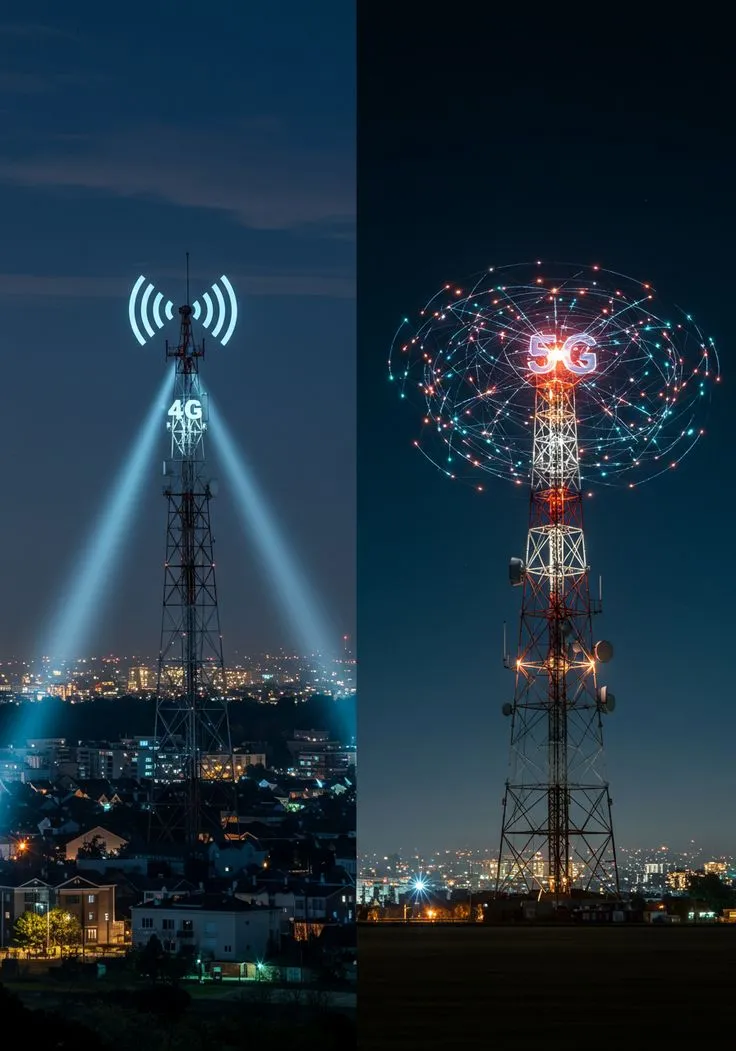
The most noticeable distinction between 4G and 5G lies in performance metrics. 5G offers significantly higher speeds, often 5-10 times faster in practice, revolutionizing downloads, uploads, and streaming. For instance, a full HD movie that might take several minutes on 4G can download in seconds on 5G. Latency improvements make interactions feel instantaneous, benefiting online gaming, video calls, and real-time data applications. Capacity represents another leap: 5G handles far more simultaneous connections without degradation, addressing congestion in crowded locations like stadiums or cities. While 4G excels in widespread, reliable coverage using lower frequencies, 5G’s higher bands provide speed but shorter range, requiring denser infrastructure. Energy efficiency also improves in 5G, potentially extending device battery life despite higher performance. These differences make 5G transformative for data-intensive and low-latency scenarios, though 4G remains highly capable for standard usage.
Coverage, Infrastructure, and Real-World Deployment
4G networks boast near-universal coverage in many regions, with mature infrastructure supporting consistent performance across urban, suburban, and rural areas. 5G deployment varies by frequency: low-band offers broad reach similar to 4G but modest speed gains, mid-band balances speed and coverage for most users, and high-band (mmWave) delivers ultra-fast speeds in limited, dense spots. Operators combine these for comprehensive service, with 5G often leveraging existing 4G sites initially. Real-world rollout focuses on cities first, gradually expanding. Challenges include higher infrastructure costs for denser networks and signal penetration issues with higher frequencies. Users in well-covered areas experience seamless transitions between generations, with devices intelligently switching based on signal strength and needs. Ongoing investments continue improving 5G availability and reliability worldwide.
Applications and Use Cases Transforming Industries
4G enabled the mobile broadband era, supporting streaming, social media, and basic cloud access. 5G unlocks advanced applications requiring high bandwidth and low latency. Enhanced mobile broadband delivers immersive 4K/8K video and augmented reality experiences. Massive machine-type communications power smart cities, industrial IoT, and connected agriculture. Ultra-reliable low-latency communication supports autonomous vehicles, remote healthcare, and mission-critical operations. For consumers, benefits include faster downloads, smoother gaming, and reliable hotspot usage. Businesses gain from private networks, real-time analytics, and efficient supply chains. As 5G matures, it facilitates innovations like holographic communication and advanced telemedicine, redefining possibilities across sectors while building upon 4G’s reliable foundation.
Choosing Between 4G and 5G: Practical Considerations
For most everyday activities—browsing, messaging, standard streaming, and navigation—4G provides sufficient performance with excellent coverage and affordability. 5G shines for power users needing high speeds, low lag, or support for multiple devices. Factors like location, device compatibility, and usage patterns influence the decision. In areas with strong 5G, benefits are immediate for data-heavy tasks. Cost considerations include potential higher plan prices for 5G access. Future-proofing favors 5G-ready devices as networks expand and new applications emerge. Many users benefit from dual-support phones that seamlessly utilize both technologies. Evaluating personal needs against network realities ensures optimal connectivity without unnecessary expense.
The Future of Mobile Networks and Beyond 5G
The transition from 4G to 5G represents an ongoing evolution rather than a complete replacement. Hybrid networks will coexist for years, with 4G providing fallback reliability. Advancements in 5G Standalone architecture promise even greater independence and capabilities. Looking ahead, research into 6G explores terahertz frequencies, AI integration, and sensing capabilities for even more immersive experiences. Sustainability efforts focus on energy-efficient designs to support growing demands. For users and businesses, staying informed about developments ensures leveraging the best available technology. The continued convergence of mobile networks with computing and AI will further blur lines between digital and physical worlds, driving innovation across society.
Conclusion: Navigating Modern Mobile Connectivity
Understanding 4G and 5G reveals their complementary roles in powering contemporary communication. While 4G delivers reliable, widespread access for standard needs, 5G introduces transformative speed, responsiveness, and capacity for advanced applications. Choosing appropriately depends on usage, location, and priorities, with most benefiting from devices supporting both. As infrastructure expands and technologies mature, mobile networks will continue enabling new possibilities in work, entertainment, and daily life. Staying adaptable and informed positions users to maximize connectivity benefits in an increasingly connected world.
