
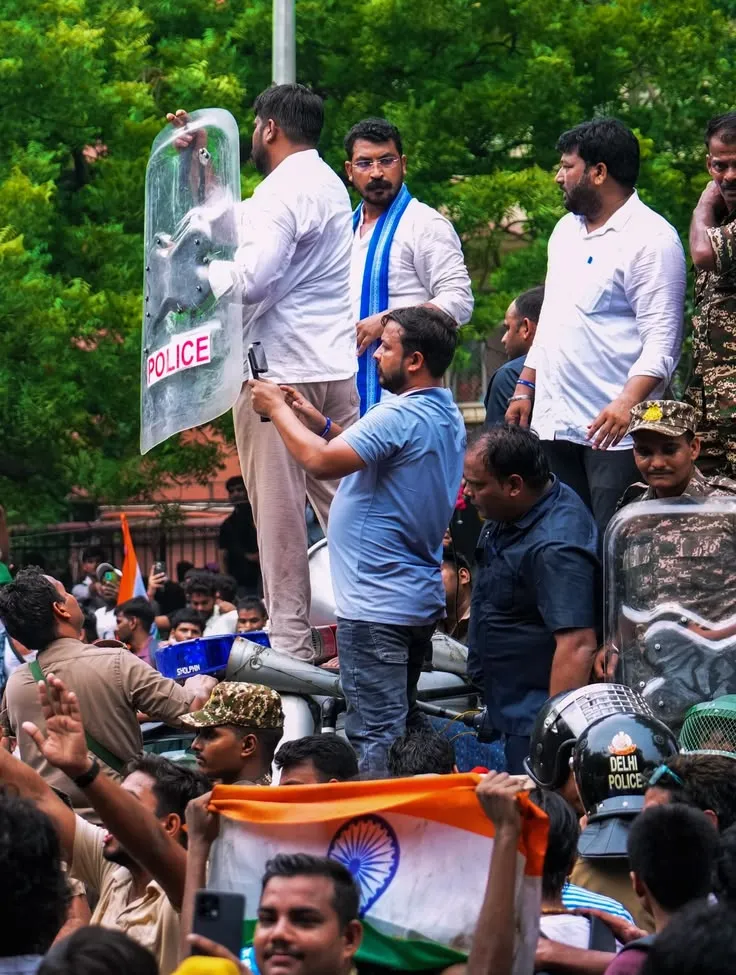
Thousands of job aspirants marching towards the Jharkhand Assembly in Ranchi faced water cannons, tear gas and baton charges on Monday as their protest over alleged recruitment examination irregularities entered its seventeenth day. Demonstrators breached multiple police barricades before being stopped near the final security cordon, while the Assembly, which was in session, was adjourned for the day. The confrontation underscored the deepening deadlock between aspirants demanding systemic reform and the state administration.
The March Towards the Assembly
The procession began around 10.30 a.m. from outside the old Assembly complex in Dhurwa. Carrying the national flag and placards, the protesters raised slogans calling for the cancellation of several recruitment examinations, comprehensive reforms in the Jharkhand Public Service Commission and the Jharkhand Staff Selection Commission, and an independent investigation, preferably by the Central Bureau of Investigation.
Their destination was the new Vidhan Sabha building. The route of roughly four kilometres had been fortified with successive layers of barricades, barbed wire in places, and a heavy deployment of more than 1,500 personnel drawn from the Rapid Action Force, Indian Reserve Battalion, district police and quick-response teams. Prohibitory orders were in force.
Despite the security arrangements, the marchers crossed one barricade after another. The agitation coincided with Chief Minister Hemant Soren’s fifty-first birthday, adding a layer of political symbolism to the day’s events.
Police Action Near the Final Barricade
When the protesters reached the last major barricade near Jagannathpur Temple on the approach to the Assembly, police deployed water cannons. Videos and eyewitness accounts showed demonstrators responding by waving tricolours and, in some instances, breaking into dance. The situation escalated when sections of the crowd attempted to push forward.
Police then resorted to a lathi charge. Several rounds of tear gas shells were fired when the demonstrators were approximately two hundred metres from the Assembly complex. Protesters later claimed that batons had been used on their heads, arms and faces, and that some women students had sustained injuries. One demonstrator described the action as “barbaric,” insisting that the protest had remained peaceful until force was used.
Authorities maintained that the measures were necessary to prevent the crowd from reaching the legislature and to maintain order while the House was in session.
Assembly Proceedings Disrupted
The Jharkhand Assembly was sitting when the march intensified. Amid the reports of protesters closing in on the premises and the use of force outside, the House was adjourned for the day. The disruption highlighted how the street agitation had begun to affect the functioning of the state’s highest legislative body.
Core Demands and the Stalemate
At the heart of the seventeen-day protest lie allegations of paper leaks and irregularities in examinations conducted by the JPSC and JSSC, including the 14th Combined Civil Services Examination. Aspirants have demanded the cancellation of multiple tests they consider compromised, structural reforms in the two recruitment bodies, and a probe free from any perception of state influence.
The state government has held several rounds of talks with protest representatives. Officials have stated that a large majority of the demands have been accepted. Protest leaders, however, have countered that only a limited number of examinations—three out of the thirteen they wanted scrapped—have been agreed upon for cancellation. They have refused to settle without a firm commitment to a CBI investigation or an equivalently independent mechanism.
A parallel development on the same day saw the state CID arrest former JPSC chairman L Khiangte in connection with the examination controversy, particularly the empanelment of a previously blacklisted company for examination-related work. The arrest formed part of the ongoing state-level inquiry but did not satisfy those insisting on a central agency probe.
Broader Context of the Agitation
The current movement has drawn energy from wider discontent among young job-seekers across India over the integrity of competitive examinations. In Jharkhand, the scale of participation, the willingness to sustain a prolonged sit-in and hunger strikes by some leaders, and the decision to march on the Assembly reflect a loss of confidence in the existing recruitment system.
For the administration, the challenge has been to address genuine grievances without appearing to yield to pressure that could reopen settled examinations or undermine the authority of state institutions. The heavy security deployment and the use of force on Monday illustrated the difficulty of managing large, determined crowds once negotiations reach an impasse.
Injuries, Accountability and Next Steps
Claims of injuries on both sides will require transparent documentation and appropriate medical and legal follow-up. Questions about the proportionality of the force used, the adequacy of prior dialogue, and the conditions under which future protests can take place are likely to surface in the coming days.
Whether the day’s events produce a breakthrough or further hardening of positions remains to be seen. Protest leaders have indicated they will continue until their core demand for an independent probe is met. The government, for its part, has pointed to the arrests already made and the concessions offered in talks as evidence of seriousness.
A Test of Institutional Response
The scenes outside the Jharkhand Assembly on 10 August captured a familiar yet unresolved tension in Indian public life: the gap between the aspirations of large numbers of educated young people and the credibility of the systems that are supposed to offer them fair opportunity. When that credibility erodes, the street becomes the arena in which grievances are expressed, sometimes at the cost of order and safety.
An adjourned Assembly, tear gas in the air, and thousands of aspirants still unconvinced by official assurances mark a difficult moment for the state. Restoring trust will require more than containment of protests. It will require demonstrable action that addresses the substance of the allegations and rebuilds confidence that recruitment examinations in Jharkhand can once again be regarded as fair. Until then, the deadlock that brought marchers to the gates of the legislature is likely to persist.
Read more – mesmerizemovies.com
